 EN
EN ES
ES
PA46 Cable Ties: Thermal Stability and Reliable Fastening in 150°C Environments

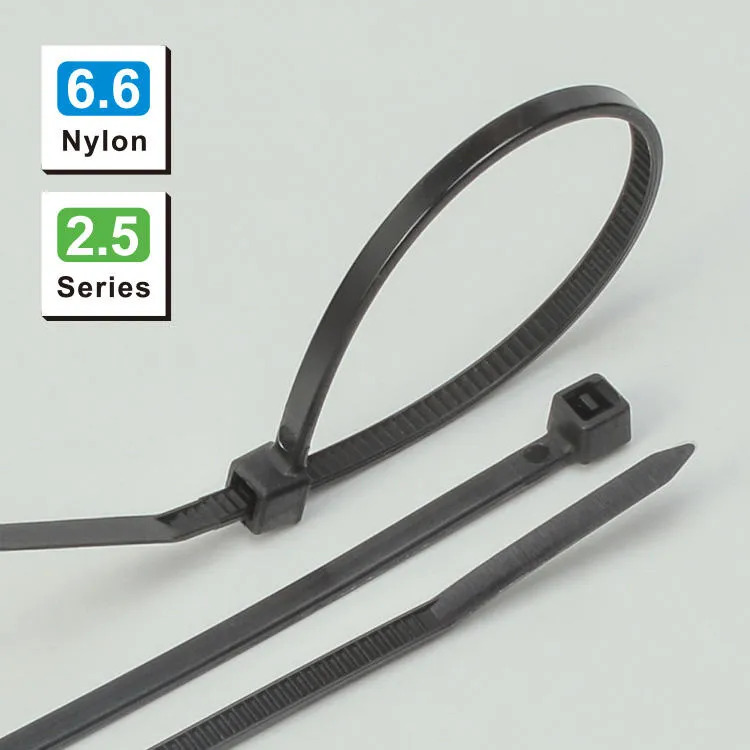
Standard PA66 zip ties often become brittle, elongate, or snap when exposed to sustained heat. For engineers managing cable routing in engine compartments or high-load electrical assemblies, this mechanical failure isn't just a nuisance—it’s a system risk. PA46 (Polyamide 46) cable ties exist to bridge the gap between standard nylon and expensive speciality polymers like PEEK.
Technical Core: Why PA46 Outperforms PA66
The primary difference lies in crystallinity. PA46 has a more symmetrical molecular structure and a higher concentration of amide groups than PA66. In a practical work environment, this provides three distinct mechanical advantages:
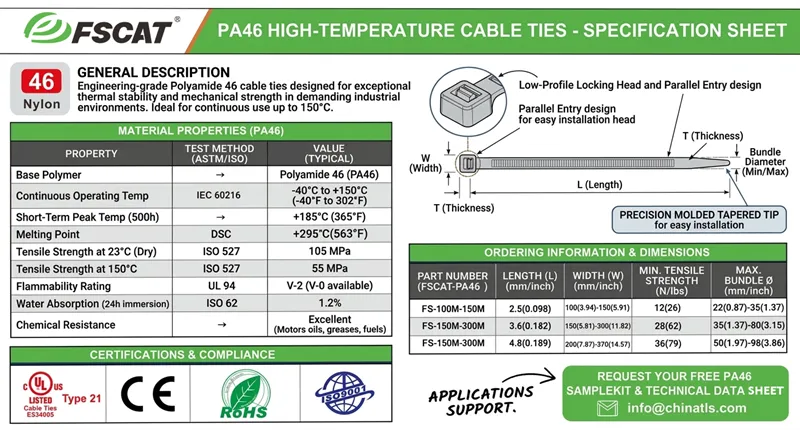
1.High Heat Deflection: While PA66 softens significantly as it approaches 100°C, PA46 maintains its structural rigidity and clamping force up to 150°C (302°F) continuous use.
2. Resistance to Thermal Creep: Under constant tension, lower-grade plastics "creep" (permanently stretch) over time, especially when hot. PA46’s dense molecular bonding resists this deformation, ensuring bundles stay tight.
3. Fatigue Endurance: In automotive or robotic applications involving constant vibration, PA46 offers superior resistance to cyclic stress, preventing micro-cracks that lead to sudden snapping.
Material Selection: PA46 vs. Alternatives
Choosing the right material is a balance of performance and budget. The following data highlights where PA46 sits in the hierarchy of high-temperature fasteners:
| Product Name | FSCAT Cable Ties | |||
| Operating Temperature | Polyamide 6 | Polyamide 6.6 | Polyamide 6.6HS | Polyamide46 |
| Max. | 85℃(185℉) | 85℃(185℉) | 105℃(221℉) | 195℃(383℉) |
| Min. | -5℃(-5℉) | -10℃(-10℉) | -40℃(-40℉) | -40℃(-40℉) |
| UV light/ozone | Average | Average | Good | Average |
| Oils and greases | Good | Excellent | Average | Average |
| Solvents | Good | Good | Average | Average |
| Petrol | Good | Excellent | Average | Average |
| Flammability | UL94V-2 | UL94V-2 | UL94HB | UL 94-V2 |
Not sure which grade fits your thermal environment? Get expert selection advice
Critical Application Zones:
PA46 ties are engineered for specific "failure-prone" zones where standard nylon is insufficient.
Automotive Powertrains: Securing sensors and wire looms near turbochargers, EGR valves, and cooling systems.
Power Electronics: Fastening heavy-gauge cables in transformers, switchgear, and high-density server racks where localised heat buildup occurs.
Industrial Automation: Routing cables on robotic arms and motors where internal friction generates heat and mechanical stress.
Manufacturing Precision & Quality Control:
A PA46 cable tie is only as good as the moulding process behind it. Because PA46 is highly sensitive to moisture and cooling rates during production, FSCAT implements a strict localised control strategy:
Dehumidified Processing: We eliminate moisture during the injection phase to prevent hydrolytic degradation, which ensures the ties don't arrive brittle.
Consistent Crystallisation: Optimized mold temperatures ensure every batch reaches its peak mechanical density.
Global Compliance: All units are tested to meet UL94 V-2 flammability standards and are fully RoHS and REACH compliant.
FAQ: Technical Clarifications
Q: Can I use PA46 for outdoor high-heat applications?
Standard PA46 is optimised for heat, not UV. If your application is outdoors (e.g., solar arrays or rooftop HVAC), we recommend our UV-stabilised PA46 variant, which incorporates carbon black to prevent sun-induced cracking.
Q: Does PA46 offer better chemical resistance than PA66?
Yes. Due to its higher crystallinity, PA46 shows superior resistance to automotive fluids, greases, and industrial oils, even at elevated temperatures.
Q: Is it a direct drop-in replacement for PA66?
Absolutely. It uses the same installation tools and ergonomic designs as standard zip ties, requiring no changes to your assembly line process.
Engineering Support & Samples
Relying on generic specifications can lead to costly field failures. To ensure PA46 is the right fit for your thermal environment, we provide full technical data sheets (TDS) and validation support.
Need to verify performance in your own facility?
[Contact our Engineering Team] to request a Free Sample Kit of PA46 Cable Ties. We can also provide custom sizing and bulk B2B pricing for global export.