 EN
EN ES
ES
Why ETFE (Teflon) Cable Ties are the Ultimate Choice for Zero-Failure Missions

ETFE (Ethylene Tetrafluoroethylene) cable ties, often known as "Teflon-grade" fasteners, are high-performance fluoropolymer solutions designed for environments where standard plastics disintegrate. Featuring a continuous operating temperature of 150℃, exceptional radiation resistance (200MRad), and near-total chemical inertness, ETFE zip ties are essential for semiconductor cleanrooms, nuclear power plants, and aerospace wiring. When standard nylon fails due to acid corrosion or thermal embrittlement, ETFE ensures long-term system integrity.
1. What Are ETFE Cable Ties? (The "King of Plastics" Pedigree)
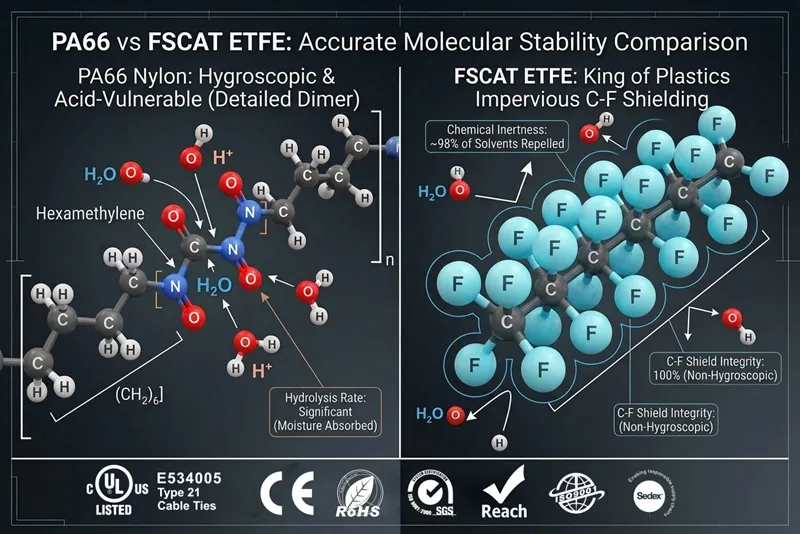
ETFE cable ties are moulded from a specialised fluoropolymer that combines mechanical toughness with the high-end chemical resistance of the Teflon family.
In engineering terms, the molecular secret lies in the strong carbon-fluorine (C-F) bonds. These bonds are significantly more stable than the carbon-hydrogen bonds found in standard nylon zip ties. This molecular shield allows ETFE tie wraps to remain flexible and strong even when submerged in concentrated sulfuric acid or exposed to intense gamma radiation.
2.ETFE vs. PA66: The Failure Analysis Perspective
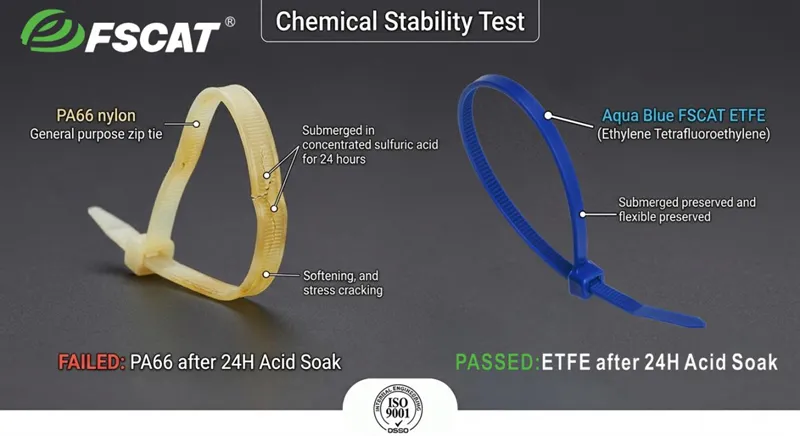
To understand why ETFE is necessary, we must look at where standard materials reach their breaking point.
A.Thermal Endurance:150℃vs 85℃
Technical Root Cause: Standard PA66 begins thermal oxidation at 85℃, leading to "chain scission" and immediate brittleness. ETFE cable ties maintain a continuous service temperature of 150℃(302℉)
Industrial Impact: In engine bays or industrial drying ovens, a PA66 tie will snap if touched after 6 months; an ETFE tie will remain as ductile as the day it was installed.
B. Chemical Inertness: Acid Resistance vs. Dissolution
From a manufacturing standpoint, PA66 is highly susceptible to "acidic hydrolysis." Even exposure to mild acidic vapours in chemical plants can liquefy the locking pawl of a nylon binder.
The ETFE Advantage: ETFE fasteners are hydrophobic and chemically inert. They resist 98% of industrial solvents, acids, and bases, making them the only viable choice for semiconductor "wet bench" applications.
B.Radiation Stability: 200 MRad vs. Total Degradation
In nuclear or medical sterilisation environments, ionising radiation turns standard plastics into a chalky substance. ETFE zip ties are rated to withstand up to 200 MegaRads of radiation without losing their 50 lbs (222N) tensile strength.
3. High-Reliability Application Scenarios
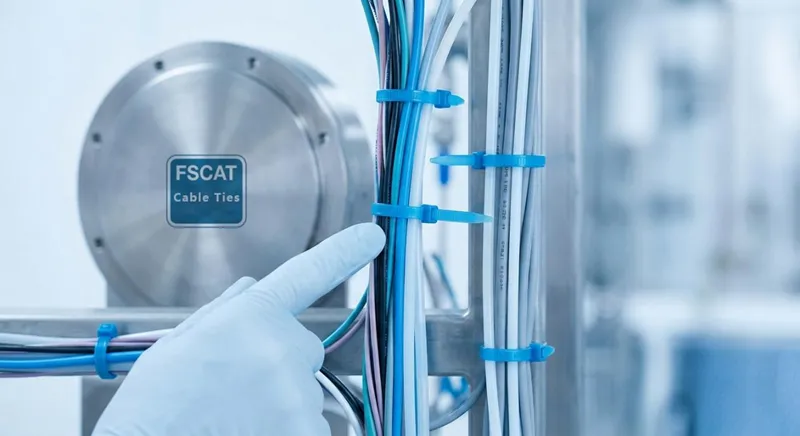
1)Semiconductor Manufacturing: ETFE ties prevent metal ion contamination and withstand the harsh etching chemicals used in wafer production.
2)Aerospace & Satellite Systems: Low outgassing properties and resistance to high-altitude radiation make ETFE the aerospace industry standard.
3) Offshore & Marine Oil Rigs: Salt spray and extreme UV degrade standard plastics in months. ETFE binders provide a 20+ year maintenance-free lifecycle in maritime environments.
4. Why the "Aqua Blue" Colour Matters?
You will notice most ETFE cable ties are manufactured in a distinct Aqua Blue. From an inspection standpoint, this is not for aesthetics. It is a safety coding mechanism. It allows site inspectors to visually confirm that a high-performance fluoropolymer tie was used in a critical zone, preventing the accidental substitution of lower-grade blue nylon ties.
5. Manufacturing Excellence: The FSCAT Precision
Moulding ETFE is vastly more complex than moulding Nylon. ETFE resin is corrosive to standard steel and has a very narrow processing window.
1)Corrosion-Resistant Tooling: FSCAT uses specialised alloy moulds to ensure no metallic impurities enter the ETFE matrix.
2)Zero-Regrind Policy: We use 100% virgin ETFE resin to ensure the chemical resistance ratings meet UL and ISO standards perfectly.
3)Hot Runner Optimisation: This ensures the locking head of the zip tie has a consistent molecular density, preventing the "head-pop" failure common in lower-quality fluoropolymer products.
Technical FAQ for Engineers
Q: Are ETFE zip ties the same as PFA or PTFE ties?
A: While all belong to the fluoropolymer family, ETFE offers the best balance of mechanical strength and injection-moldability. PTFE (Teflon) is too soft for high-tension cable ties, whereas ETFE provides the necessary "bite" and tensile strength (up to 50 lbs) required for industrial bundling.
Q: Can ETFE ties be used in vacuum environments?
A: Yes. ETFE tie wraps exhibit very low outgassing, making them ideal for space applications and high-vacuum laboratory equipment where volatile contaminants must be avoided.
Q: What is the ROI of switching to ETFE?
A: While the initial cost is higher, the Long-term ROI is achieved by eliminating "emergency shutdown" costs. Replacing a snapped $0.05 tie in a $10M chemical line can cost thousands in downtime; ETFE eliminates this risk for the life of the system.