 EN
EN ES
ES
Nylon vs. Stainless Steel Cable Ties
When a maintenance supervisor in a coastal Florida plant replaced corroded nylon ties on outdoor signaling equipment for the third time in two years, he asked a simple question: “Isn’t there something that just lasts?” That moment led him to test stainless steel cable ties. But the switch wasn’t a pure win – metal ties brought their own headaches, from edge sharpness to installation time.
This kind of trade-off happens daily in workshops, data centers, and construction sites. Both nylon and stainless steel cable ties are everywhere, yet their performance under real-world conditions couldn’t be more different. Below we’ll walk through six critical comparison points – not to declare an absolute winner, but to help you match the material to your actual working environment.
1. Mechanical strength: When “tight enough” isn’t enough
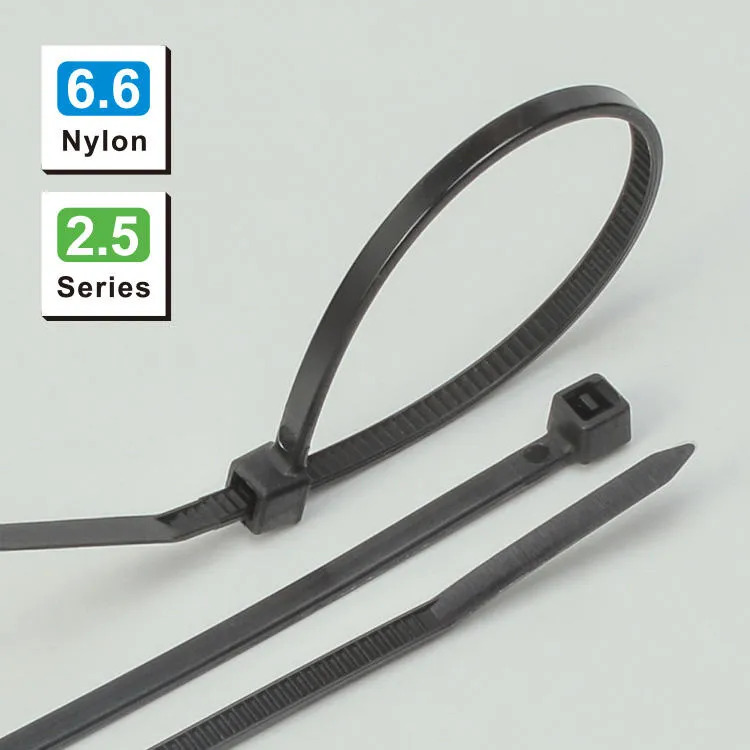
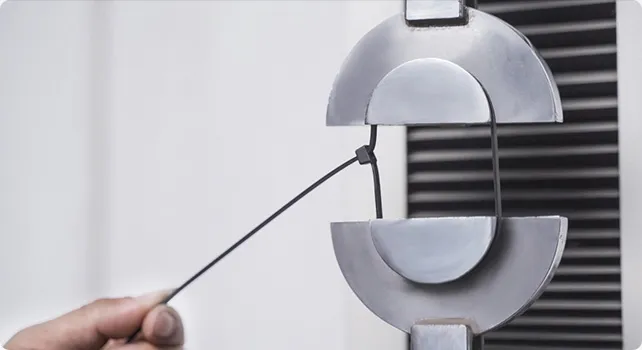
On paper, standard nylon ties (typically made of PA66) offer tensile strengths from 18 lbs to over 250 lbs depending on width. That’s plenty for bundling wires inside a control cabinet or organizing cables under a desk. However, nylon can slowly relax under sustained load – a phenomenon called creep. Over months or years, a once-tight bundle may loosen.
Stainless steel ties (most often 304 or 316 grade) have no creep issue. Their tensile strength starts where nylon’s tops out, often exceeding 300 lbs even in narrow bands. For applications like seismic bracing, outdoor antenna mounts, or securing heavy conduit on vibrating machinery, steel provides a permanent lock.
But strength alone misleads. A steel tie that’s over-tightened can cut into cable jackets or damage soft insulation. The choice isn’t “stronger is better” – it’s about whether your load requires metal-grade security or if nylon’s ample strength suffices.
2. Environmental enemies: UV, chemicals, and extreme temperatures
Here is where the two materials diverge dramatically.
-
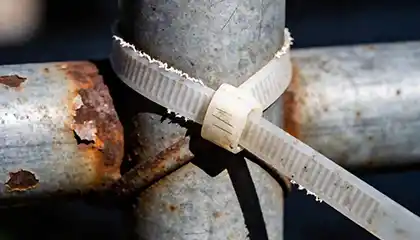
UV radiation: Standard nylon (even UV-stabilized grades) degrades outdoors. After 12–18 months of direct sunlight, surface cracking appears, and tensile strength can drop by 30–50%. Stainless steel laughs at UV – no change after decades.
-
Temperature range: Nylon typically handles -40°C to 85°C (-40°F to 185°F). Brief excursions higher are possible, but prolonged heat above 105°C (221°F) causes embrittlement. Stainless steel operates from -80°C to 538°C (-112°F to 1000°F) without loss of properties.
-
Chemicals & moisture: Nylon absorbs moisture (up to 2.5% by weight in humid air), which slightly reduces strength but also makes it more flexible. It resists oils, fuels, and many solvents but fails against strong acids or bases. Stainless steel (especially 316) fights off salt spray, chlorine, sulfuric acid, and most industrial corrosives – but can suffer crevice corrosion if left wet in stagnant conditions.
A real-world example: A water treatment plant used nylon ties to secure sensor cables inside a chlorine dosing room. After six months, every tie had turned brittle and snapped. Switching to 316 stainless steel solved the problem – but the metal ties cost five times more per piece.
3. Installation speed and safety
Nylon ties are famous for their one-pull installation. With a standard tensioning tool or even just pliers, a worker can fasten 100 ties per hour. No special training required.
Stainless steel ties demand more care. You need a proper tensioning tool (a manual or pneumatic cutter-tensioner) to avoid over-tightening and to cut the excess tail flush. A poorly trimmed steel tail is razor-sharp – a known cause of hand lacerations and damaged wire insulation. According to a 2022 safety bulletin from an industrial maintenance association, steel tie cuts account for nearly 8% of electrical cabinet service injuries.
For indoor, dry, low-traffic areas, nylon’s speed and safety make it the default. For harsh environments where a failed tie could cause downtime or hazard, the extra installation time for steel is justified.
4. Electrical considerations: Conductivity and dielectric strength
Never overlook this if you work near live circuits.
-
Nylon is an excellent electrical insulator. Its dielectric strength exceeds 15 kV/mm. You can safely bundle low-voltage signal wires or even 480V power cables without worrying about creating unintended conductive paths.
-
Stainless steel is highly conductive. One steel tie that accidentally bridges two terminals or chafes through a wire’s insulation can cause a short circuit, arc flash, or ground fault. Some facilities require steel ties to be coated (e.g., with polyester or nylon sleeves) when used inside electrical panels – adding cost and complexity.
If you need metal-grade durability near electronics, consider coated stainless steel ties or plastic-coated aluminum ties. But for most electrical applications, non-conductive fastening is safer.
5. Cost and lifecycle value
A common mistake is comparing only the unit price. Let’s break it down:
| Feature | Nylon Cable Tie (standard) | Stainless Steel Tie (304 grade) |
|---|---|---|
| Typical cost per piece (100-pack) | $0.02 – $0.15 | $0.80 – $3.50 |
| Tooling required | None or $10 pliers | $80 – $250 tensioning tool |
| Installation time per 100 ties | ~1 hour | ~2.5 hours (with tool) |
| Lifespan indoors | 10+ years | 50+ years |
| Lifespan outdoors (direct sun) | 1–3 years | 20+ years |
| Replacement labor cost | High if frequent | Near zero |
For a temporary outdoor event or an indoor wiring project with easy access, nylon wins on total cost. But for a solar farm, offshore platform, or bridge lighting system where a replacement requires a bucket truck and lane closure, the initial premium for stainless steel pays back quickly.
Data based on typical industrial pricing and labor rates as of 2024. Actual costs vary by supplier and volume.
6. Fire resistance and smoke emission
Building codes (e.g., NEC, NFPA 262) sometimes mandate flame-retardant materials in plenum spaces or air handling areas.
-
Nylon is inherently flammable but can be formulated with halogen-free flame retardants (UL94 V-2 or V-0 ratings). When it burns, it produces some smoke and dripping, though less than PVC.
-
Stainless steel is non-combustible – no smoke, no dripping, no flame spread. For cleanrooms, tunnels, or nuclear facilities, this is a non-negotiable advantage.
If your project requires plenum ratings, always check the specific certification of the product you’re buying. Not every nylon tie on the market is flame-retardant.
So which one should you choose?
Ask yourself three questions:
-
Environment – Outdoors, wet, chemical, or salty? → Lean stainless steel (316 grade for marine). Indoors, dry, UV-free? → Nylon is likely fine.
-
Safety criticality – Would a tie failure cause injury, equipment damage, or regulatory violation? → Choose steel. For general organization → Nylon.
-
Installation access – Hard to reach or requiring a lift? → You want the longer lifespan of steel. Easy workbench assembly? → Nylon saves money.
Many projects actually use both: stainless steel for primary structural lashing, and nylon for secondary cable dressing. Hybrid strategies often deliver the best balance.
When you need reliable nylon fastening for indoor or controlled environments
For thousands of everyday applications – from server rack wiring to automotive harnesses to home workshop organization – high-performance nylon cable management solutions remain the go-to choice. They’re quick to install, safe around electricity, and cost-effective for most indoor and sheltered outdoor use.
If you’re looking for a trusted source of durable, UV-stabilized options that meet UL and RoHS standards, feel free to explore our range of cable management solutions – designed for professionals who value both efficiency and reliability. Whether you need standard natural nylon, heat-stabilized grades, or flame-retardant variants, you’ll find specifications and bulk pricing there.