 EN
EN ES
ES
2026 Trends in Nylon Cable Ties

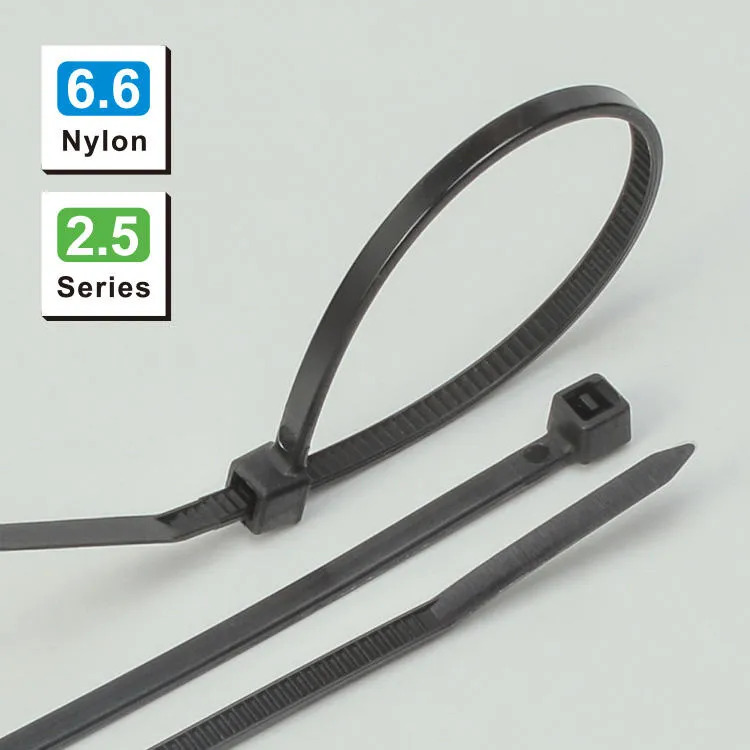
Let’s be honest—nylon fastening straps don’t usually make headlines. But take a closer look at the industrial supply chain in 2026, and you’ll find that these humble bundling components are quietly undergoing a major transformation.
Think about it. Every data center, every automotive wiring harness, every solar installation relies on these loops to hold critical infrastructure together. And now, driven by corporate ESG commitments, Industry 4.0 digitization, and tightening global safety regulations, the market for nylon-based fastening solutions is shifting faster than ever before.
What exactly is changing? And what should procurement professionals, engineers, and facility managers watch for when selecting reliable bundling fasteners this year? Let’s break down the three most important trends defining the landscape in 2026.
Trend 1: The Rise of Post-Industrial Recycled Nylon
Sustainability is no longer a “nice-to-have” in industrial components—it’s becoming a baseline expectation. In 2026, the biggest story in nylon fastening materials is the rapid adoption of Post-Industrial Recycled (PIR) nylon 6.6.
Major manufacturers are now producing web straps made from up to 100% post-industrial plastic waste, combining circular economy principles with the proven mechanical performance of virgin-grade polyamide. Compared to conventional options made from virgin materials, the PIR variants reduce the carbon footprint by up to 36% while maintaining the same strength, durability, and safety characteristics. For companies tracking ESG metrics, switching to these recycled-content solutions delivers measurable environmental impact reduction without technical compromise.
The numbers behind this trend are striking. Currently, only about 9% of global plastic waste is recycled, yet projections suggest that by 2050, up to 12 billion tonnes of plastic could pollute the environment. Industrial components like plastic securing straps represent an enormous opportunity to close the loop, because they’re produced in massive volumes and can be manufactured from carefully controlled post-industrial waste streams.
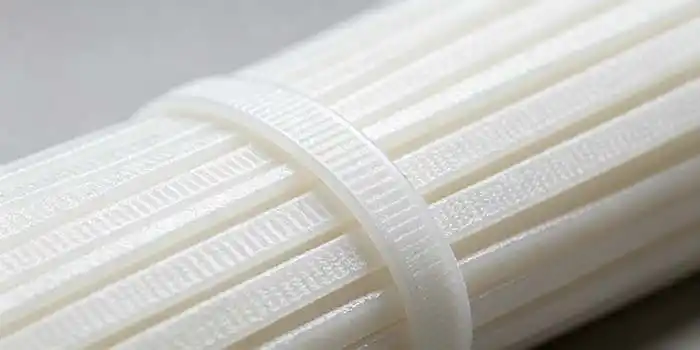
One notable example comes from HellermannTyton, which has upgraded its T- and OS-Series fastening loops to use PIR-recycled polyamide 6.6. This heat-stabilized, high-impact-modified material is highly durable and does not require moisture conditioning—a significant advantage in demanding industrial environments. Tensile strengths range from 80N to 535N, making these recycled-content fasteners suitable for automotive and electrical applications that previously required virgin-grade materials.
For buyers, the key takeaway is clear: recycled content no longer means sacrificed performance. When evaluating suppliers in 2026, ask specifically about PIR content certification and UL-validated recycled content claims. The companies leading this shift are the ones positioning themselves for long-term supply chain resilience.
Trend 2: Smart Fasteners with Embedded Tracking Intelligence
If sustainability is the environmental driver of change in 2026, then digitization is the operational one.
Industrial bundling straps are evolving from passive utility items into smart components with embedded identifiers. The next wave of innovation, as reported by Manufacturing Outlook Europe, sees securing ties becoming “smart components” themselves—utilizing micro-RFID tags or advanced digital markers for end-to-end traceability.
This isn’t a distant concept. RFID-integrated fastening loops are already commercially available, combining the mechanical benefits of nylon 6.6 with wireless identification capabilities. Products like HellermannTyton’s T50RFIDDHA-PA66-BK operate at 13.56 MHz (HF), offer tamper-evident features, and eliminate clerical errors while accelerating data collection for maintenance and inventory workflows.
What problems do these smart fasteners actually solve? Consider:
-
Electrical inspections. Instead of paper-based logs, inspectors scan each RFID-equipped tie to instantly access maintenance history and compliance records.
-
Asset tracking in rental and distribution. Equipment that needs to carry a serial number for tracking purposes can be secured and identified simultaneously.
-
Inventory management in harsh environments. RFID tags embedded directly into the fastening device eliminate the risk of adhesive labels peeling off in outdoor or high-vibration settings.
The portfolio for intelligent fastening hardware now includes standard nylon, metal-detectable, and stainless steel versions, available with integrated low frequency (LF), high frequency (HF), and ultra high frequency (UHF) RFID transponders. This variety means engineers can specify RF-enabled options for virtually any application—from cold storage facilities to automotive assembly lines.
Why does this matter for procurement? Because smart fasteners turn a consumable line item into a data-gathering asset. For facilities managing hundreds or thousands of cable bundles, the labor savings from automated inspections and simplified inventory tracking can quickly justify any upfront cost premium.
Trend 3: Performance-Engineered Nylon for Extreme Environments
The third major trend shaping 2026 is specialization—the move away from one-size-fits-all engineering toward application-specific formulations that handle extreme conditions.
Advanced polymers are now engineered for exceptional UV resistance, chemical tolerance, and high-heat stabilization, allowing nylon strapping solutions to perform reliably in continuous temperatures well exceeding 125°C. For automotive under-hood applications or energy-sector installations where ambient temperatures routinely push limits, these high-heat-stabilized options are becoming the new industry standard.
On the other end of the spectrum, cold-weather impact-modified polyamide 6.6 formulations remain flexible even in sub-zero conditions, with operating temperatures spanning from -40°C to +85°C for UV-resistant variants.
Fire safety has also become a prominent specification in 2026. Flame-retardant fasteners classified to UL94-V0 are increasingly mandated for electrical panels, data centers, and transportation applications. These self-extinguishing nylon 6.6 ties meet zero-halogen requirements, making them suitable for environments where smoke toxicity and fire propagation are critical concerns.
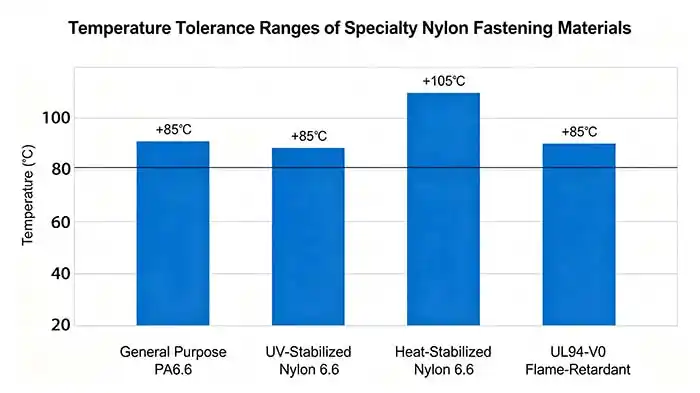
The table below summarizes key specialty formulations available in 2026, based on current product specifications:
| Material Type | Operating Temp Range | Key Features | Typical Applications |
|---|---|---|---|
| General Purpose Polyamide 6.6 | -40°C to +85°C | High tensile strength, lightweight | Indoor wiring, general bundling |
| UV-Stabilized Nylon 6.6 | -40°C to +85°C | 5–9 years outdoor life, carbon black additive | Solar farms, telecommunications, and outdoor signage |
| Heat-Stabilized Nylon 6.6 | -40°C to +105°C | Elevated max temperature, chemical resistance | Automotive engine compartments, industrial ovens |
| UL94-V0 Flame-Retardant | -40°C to +85°C | Self-extinguishing, zero-halogen | Electrical panels, mass transit, data centers |
For engineers and purchasers, the trend toward specialization means reading spec sheets more carefully than ever. Standard general-purpose loops won’t survive five years of direct sunlight or daily thermal cycling near an engine block. Matching the formulation to the actual use environment is now essential for ensuring long-term reliability and avoiding premature failure.
Market Outlook: What the Numbers Tell Us
The market context reinforces why these trends matter. The global nylon fastening solutions market is expanding steadily. Industry estimates placed the global securing strap market at approximately USD 1.71 billion in 2024, with projections reaching USD 2.97 billion by 2033—representing a compound annual growth rate (CAGR) of around 6.3%. Other sources converge on similar figures, with the broader cable management segment expected to grow at 5.91% CAGR from USD 1.59 billion in 2025 to USD 2.39 billion by 2032.
Sustainable solutions, particularly PIR-recycled and bio-based options, are consistently cited as a key growth driver in these market forecasts. As regional regulations around plastic waste and chemical content tighten worldwide, the shift toward compliant, low-carbon securing hardware will only accelerate.
Making Informed Choices in a Changing Landscape
So where does that leave procurement professionals and engineers in 2026?
The days of treating nylon fastening straps as pure commodity items are ending. Three shifts are reshaping how smart buyers approach this category:
-
Sustainability performance now matters as much as mechanical performance. PIR-recycled content is measurable and verifiable—and increasingly demanded by large OEMs and ESG-conscious corporations.
-
Connectivity is becoming a feature, not a futuristic concept. RFID-enabled bundling tools deliver real operational efficiencies for asset tracking, maintenance logging, and inventory control.
-
Material science has created genuine differentiation. UV-stabilized, heat-stabilized, flame-retardant, and cold-weather impact-modified nylon 6.6 represent distinct product categories with very different service life expectations.
Whether you’re specifying securing components for a new solar installation, managing inventory for an automotive wiring harness production line, or simply looking to reduce your facility’s environmental footprint without compromising on strength or safety, understanding these 2026 trends will help you make better, more future-proof decisions.
If you’re evaluating options for your next project, reviewing the latest nylon securing strap lineup can help you compare PIR-recycled variants, RFID-enabled smart fasteners, and specialty heat-stabilized or flame-retardant formulations side by side. The right match for your specific application requirements will depend on operating environment, asset tracking needs, and sustainability goals—but one thing is certain in 2026: the humble bundling strap has earned a closer look.
Note: The images in this article are for reference only.