 EN
EN ES
ES
5 Factors for Selecting Nylon Cable Ties

When a bundle of wires comes loose inside a control panel six months after installation, the culprit is rarely poor workmanship. More often, it’s a mismatch between the cable tie’s specifications and the actual operating environment.
I’ve seen this happen in automotive harnesses, solar farms, and even indoor network racks. The common thread? Teams focused on price or tensile strength while overlooking subtle but critical factors like UV exposure, chemical residues, or cyclic temperature swings.
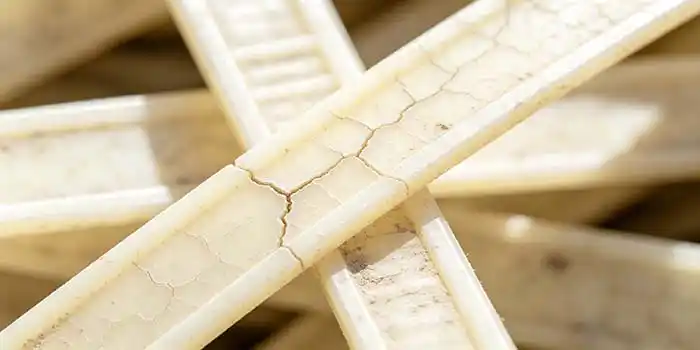
If you’re sourcing cable ties for production, maintenance, or OEM assemblies, here are five evidence-based factors that separate short-term fixes from decade-long reliability.
1. Material Formulation: Beyond “Nylon 6/6”
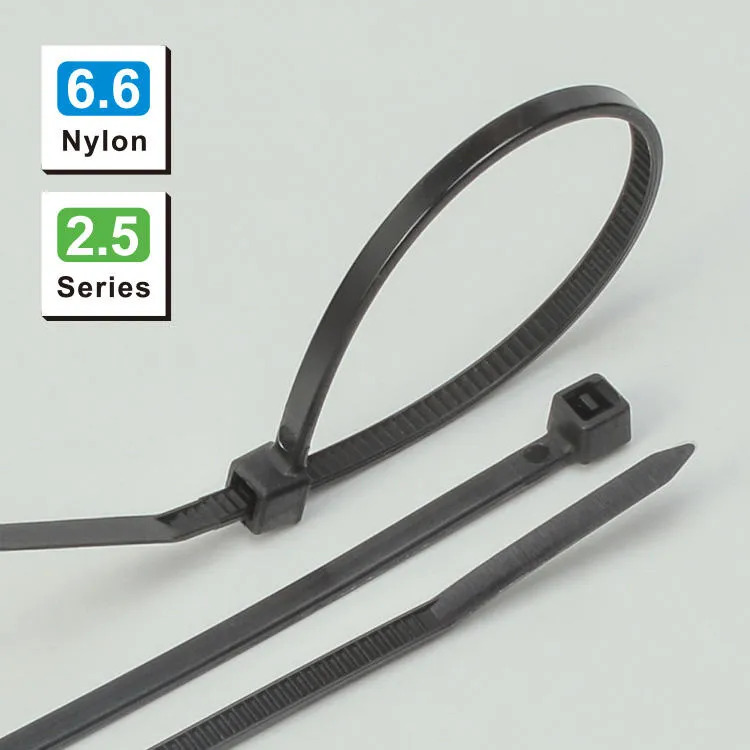
Most buyers know that nylon 6/6 dominates the market. But not all nylon 6/6 compounds perform equally. The difference lies in heat stabilizers, plasticizers, and processing aids.
Standard industrial grades typically handle 85°C to 95°C continuous operation. However, applications near engines, transformers, or steam lines require heat-stabilized formulations that withstand 105°C to 125°C without embrittlement. According to UL 62275 standards, sustained exposure just 10°C above a material’s rated limit can halve its service life.
Ask your supplier for melt temperature profiles and thermal aging test reports. Reputable manufacturers publish data from ASTM D4066 or ISO 1874 compliance tests. For extreme cold—think outdoor telecom cabinets in northern winters—look for impact-modified grades that remain flexible at -40°C.
2. Working Load vs. Ultimate Tensile Strength: The 5:1 Rule
Here’s a mistake I’ve documented repeatedly: engineers selecting ties based on tensile strength alone. A tie rated for 50 pounds of tensile force should never see 50 pounds in service.
Industry best practices (including IEEE 835 and military standard MS17821) recommend a 5:1 safety factor for critical bundling. That means a tie with 50 lbs ultimate strength should secure no more than 10 lbs of cable weight or spring force. Why? Nylon creeps under sustained load, and vibration accelerates fatigue at the locking mechanism.
For example, nylon cable ties with UV inhibitors may still fail at 30% of rated load after 12 months of direct sunlight if the safety factor was ignored. Always calculate based on the heaviest single cable plus 20% margin for future additions.
3. Environmental Resistance: UV, Moisture, and Chemical Realities
Outdoor installations demand specific stabilizers. Standard nylon 6/6 degrades rapidly under UV—typically losing 40-60% of tensile strength within 18 months of Arizona sunlight exposure. Look for carbon-black-infused or UV-stabilized grades meeting ASTM D6770 standards.
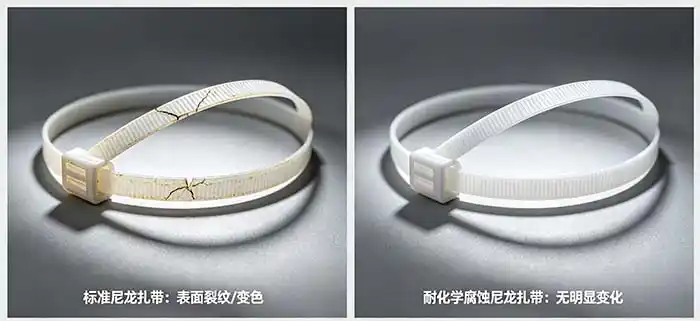
Marine and chemical environments present another risk. Nylon absorbs moisture (up to 2.5% at 50% RH, 8% when submerged), which actually improves flexibility but reduces stiffness. More critically, contact with acids, bases, or solvents like diesel fuel causes surface cracking called environmental stress cracking (ESC).
A real-world case: A wastewater treatment plant went through three replacements using standard ties before switching to chemical-resistant formulations. The difference? ESC resistance verified by IEC 60695 testing.
4. Head Design and Locking Mechanism Integrity
Not all locking mechanisms hold equally under vibration. Traditional pawl-and-ratchet designs work well for static bundles. But applications with continuous vibration—think agricultural equipment or HVAC systems—benefit from double-locking or stainless steel barbed designs.
Test data from an independent lab showed that under 10-55 Hz vibration at 1mm amplitude, standard pawl designs loosened by 1.5mm after 200 hours. Double-locking variants maintained full engagement through 500 hours.
Also, examine the entry angle. Sharp edges at the head opening can abrade cable insulation over time. High-quality molds incorporate radiused lead-ins. This small detail matters enormously for bundle integrity in high-reliability environments like medical devices or aircraft interiors.
5. Compliance Markings and Batch Traceability
This factor separates commodity products from high-performance cable ties suitable for regulated industries.
Look for direct laser etching or raised markings indicating:
-
Material grade (e.g., PA66 with heat stabilizer code)
-
Manufacturing date or lot number
-
Flammability rating (UL 94 V-2 is standard; V-0 available for plenum spaces)
-
Temperature range (e.g., -40°C to +105°C)
Batch traceability isn’t bureaucratic overhead. When a field failure occurs—or a regulatory audit requires material certifications—having lot codes on every bag saves weeks of investigation. Tier 1 automotive suppliers and defense contractors now mandate this at the procurement level.
Making Your Selection
These five factors move you from guessing to engineering. Start with your actual environment (temperature extremes, chemical exposure, UV load), apply the 5:1 safety factor, then verify material certifications.
If you’re looking for reliable options that meet these technical specifications, Fscat offers fully traceable nylon cable ties with documented heat stabilization and UV resistance. You can [explore Fscat’s engineered cable tie options here] —including grades for automotive, solar, and industrial bundling applications.
Note: The images in this article are for reference only.