 EN
EN ES
ES
How Humidity Affects Nylon Cable Tie Performance: An Engineering Guide
TL;DR / Key Specifications:
·Hygroscopic Nature: PA66 naturally absorbs 2.5% - 3.0% moisture at 50% Relative Humidity (RH).
·The Trade-off: Higher humidity = Higher Flexibility but ~10% Lower Tensile Strength.
·Critical Risk: Moisture levels below 1.2% lead to "Dry-Brittle" failure during installation.
·Storage Tip: Always keep ties in sealed PE bags; once opened, environmental equilibrium occurs within 24-48 hours.
1. The Science of "Plasticization"
Nylon 66 (PA66) is not a static material; it is chemically active with environmental moisture. Water molecules penetrate the polymer matrix, acting as a molecular plasticizer.
·In Humid Conditions: Water reduces the intermolecular forces between polyamide chains, increasing elongation at break. This makes the tie feel "tougher" and less likely to snap under vibration.
·In Dry Conditions: Without water, the chains are tightly locked. While the initial tensile strength might be higher, the material loses its ability to absorb energy, leading to "snapping" during the head-locking phase.
2.Moisture Content vs. Mechanical Performance Analysis
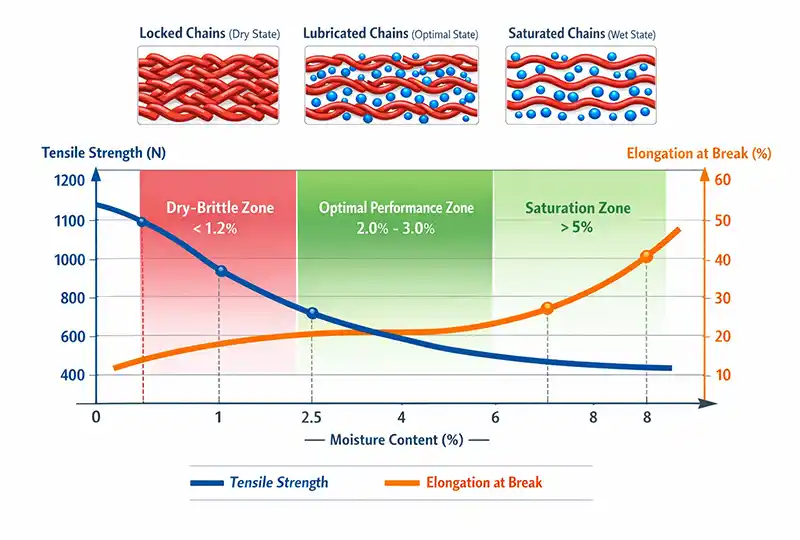
Remark:FSCAT Technical Chart showing the "Golden Ratio" of 2.5% moisture content for optimal cable tie flexibility and tensile strength.
Many customers worry about cable ties snapping or becoming brittle during winter or in dry environments. This technical chart explains exactly how we solve that problem.
To put it simply, PA66 nylon is like a plant—it needs the right amount of 'moisture' to stay alive and flexible:
The 'Dry-Brittle' Zone (Red Area): When the moisture content drops below 1.2%, the nylon chains lock up. The cable tie becomes like dry wood—stiff and very easy to snap.
The Golden Ratio (Green Area): Through our professional 'Moisture Conditioning' process, we precisely control the moisture level at around 2.5%.
This creates the perfect balance: the cable ties remain strong enough for heavy loads while staying highly flexible. Even in bone-dry seasons, our products retain their 'elasticity,' eliminating complaints about snapping. This attention to material science is the secret behind our superior quality reputation.
3. Performance Comparison: PA66 vs. PA12 vs. Weatherable Materials
For projects in extreme climates (Deserts or Tropical Coasts), material selection must shift based on moisture sensitivity:
|
Material Type |
Moisture Absorption |
Stability in 90% RH |
Best Use Case |
|
Standard PA66 |
2.5% - 8% (Sat.) |
Moderate (Softens) |
Indoor, Climate-controlled |
|
PA12 (Nylon 12) |
< 0.5% |
Excellent |
Solar Farms, Marine, Outdoor |
|
Stabilized PA66 |
2.5% |
Good |
Automotive Engine Bays |
4. Practical Storage & Installation Rules for B2B Buyers
To prevent field failures and high return rates, FSCAT recommends the following industry-standard protocols:
The 24-Hour Rule: In dry winter climates, cable ties removed from sealed bags for more than 24 hours can lose enough moisture to become brittle.
Conditioning Secrets: Professional manufacturers like FSCAT utilize specialized water-injection vacuum packaging. This ensures that even after months in shipping containers, the ties arrive with the optimal 2.5% moisture content.
Avoid "Over-Hydration": Storing ties in standing water is a mistake. It can lead to "swelling," making the pawl inside the head too soft to lock effectively.
5. Technical FAQ for Engineers
Q: Why did my cable ties snap immediately during a cold winter installation?
A: Cold air holds very little moisture. The ties likely reached an equilibrium moisture content below 1%, reaching a "glassy state" where they lose all flexibility.
Q: Does humidity affect the UL94 Flammability rating?
A: Generally, no. While moisture affects mechanical strength, the chemical flame retardancy remains stable within standard operating humidity ranges.
Q: Should I buy PA12 instead of PA66 for high-humidity regions?
A: If dimensional precision and constant tensile strength are critical (e.g., in aerospace or solar), PA12 is superior because it is virtually unaffected by humidity.
Conclusion: Don't Blame the Cable Tie, Check the Humidity
Most "quality issues" reported by users are actually environmental conditioning issues. Selecting a manufacturer like FSCAT—who understands the science of moisture balance and provides specialized packaging—is the most cost-effective way to ensure long-term system reliability.
Need a material that survives the desert or the tropics?